 11
11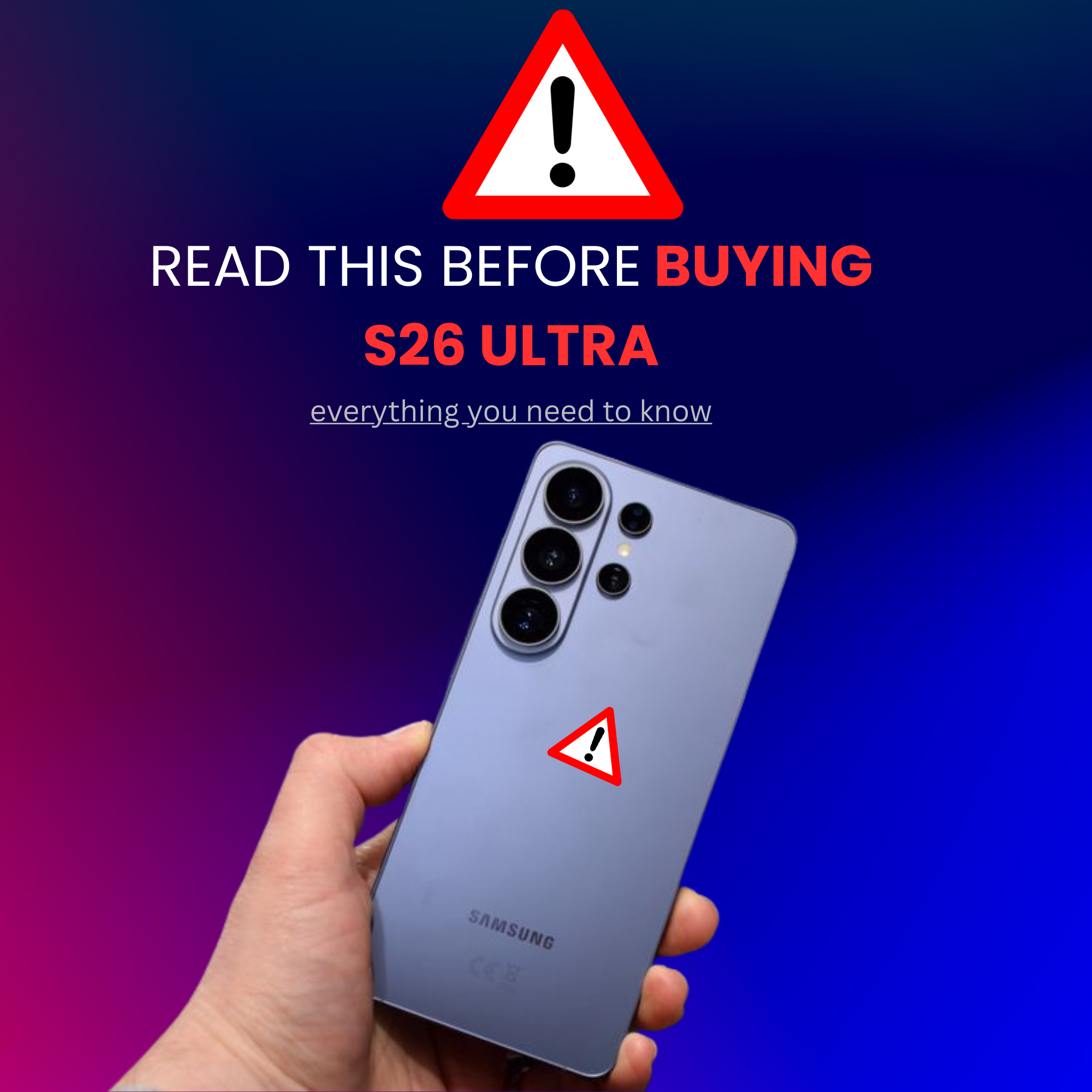
Samsung has officially taken the wraps off the Galaxy S26 Ultra, its new top‑of‑the‑line slab phone for 2026. On paper, it’s exactly what you’d expect: same 6.9‑inch canvas, same 200‑megapixel main camera, same 5,000mAh battery capacity – just with more “Ultra” sprinkled on top.
Look a little closer, though, and the S26 Ultra is less about raw spec escalation and more about correcting a handful of long‑standing complaints about the S25 Ultra: privacy in public, charging speeds, and the feeling that paying Ultra money should unlock something genuinely exclusive.
Last year’s Galaxy S25 Ultra went all‑in on sharp lines, a titanium frame and a minimalist camera layout. Reviewers loved the look but not necessarily the feel; more than one called it “almost too minimal” and a bit sterile for such an expensive device.
The S26 Ultra softens that stance. Samsung has swapped titanium for an Armor Aluminum frame, rounded the corners and adopted a vertical pill‑shaped camera island that groups three of the four rear lenses together. It still carries IP68 water and dust resistance and Gorilla Glass Victus 2 on the back, with Gorilla Glass Armor 2 on the front. The latter drastically cuts reflections – something the S25 Ultra was already praised for, with its display described as looking like a “black hole” when turned off.
The aluminum move will be controversial. Samsung argues it improves heat dissipation and keeps durability high, but to some buyers it will simply look like a retreat from the “premium” titanium marketing of the S25 Ultra. In the hand, though, weight remains in roughly the same 218‑gram range, so don’t expect a dramatic change in heft.
Both phones share the basics: a 6.9‑inch QHD+ Dynamic AMOLED 2X panel, 1–120Hz adaptive refresh and a rated peak brightness of 2,600 nits with HDR10+ support. The S25 Ultra already set a very high bar, with CNET calling it the best phone screen available at launch and praising its brightness, color accuracy and razor‑thin bezels.
The S26 Ultra doesn’t try to out‑muscle that formula. Instead, Samsung adds two subtle but meaningful upgrades:
True 10‑bit color, which should reduce banding and improve gradients in HDR photos and video.
A hardware‑level Privacy Display mode that is unique in the mainstream market right now.
Privacy Display is the S26 Ultra’s headline feature for a reason. The panel mixes two pixel types – “Narrow” and “Wide” pixels. With the feature off, both fire normally and you get standard viewing angles. Switch it on, and only the Narrow pixels remain fully active, dramatically narrowing the angle at which the screen remains readable.
Crucially, you can tie this to specific apps or UI elements: banking apps, messaging, PIN entry, sensitive notifications. Samsung is pitching it as “privacy at a pixel level,” and early real‑world leaks suggest that, from the side, the screen genuinely looks almost black while still appearing normal head‑on.
It’s one of the few upgrades that answers a real‑world pain point – shoulder‑surfing on trains and planes – and it’s clearly something rival brands are preparing to copy over the next cycle. For commuters and business users, that alone makes the S26 Ultra feel more “2026” than “S25 Ultra Plus.”
Under the hood is where the spec sheet jumps the most. The S25 Ultra runs Qualcomm’s Snapdragon 8 Elite for Galaxy in many markets, a 3nm Oryon‑based chip that already delivered roughly 37–41% CPU gains over the S24 Ultra’s Snapdragon 8 Gen 3 in benchmarks. In daily use, reviewers had little to complain about; it was the fastest Android phone most had tested.
The S26 Ultra moves to Snapdragon 8 Elite Gen 5 for Galaxy globally, paired with faster UFS 4.1 storage and up to 16GB of LPDDR5X RAM. Qualcomm and Samsung are promising:
19% faster CPU performance
24% faster GPU performance
39% NPU (AI) performance uplift over the S25 Ultra’s chip
Those are big jumps on paper, but like last year, this is less about making the phone feel faster in basic tasks and more about enabling on‑device AI and sustained performance. Samsung has enlarged and redesigned the vapor chamber, wrapping the thermal interface material around more of the chip package to spread heat more evenly. For heavy gaming or editing long 4K/8K clips, that should matter more than the raw headline numbers.
On the battery side, Samsung has chosen consistency over spectacle. Despite months of rumors about 5,200mAh or even 5,500mAh packs, a Chinese certification and now Samsung itself confirm the S26 Ultra sticks with an advertised 5,000mAh cell, just like the S25 Ultra.
The difference is how fast you can refill it. The S25 Ultra paired that 5,000mAh battery with 45W wired charging and 15W wireless; Tom’s Guide measured an impressive 17 hours 15 minutes of endurance in web‑browsing tests, the best of any Samsung phone at the time, but noted charging was merely competitive rather than class‑leading.
The S26 Ultra keeps the same capacity but bumps wired charging to 60W and wireless to 25W with Qi2.2 support. That finally pulls Samsung closer to Chinese rivals on charging speed, even if brands like OnePlus and Xiaomi still go far beyond it. For users, the practical story is simple: similar or slightly better battery life than the S25 Ultra, but much less time tethered to the wall.
What Samsung still hasn’t addressed is capacity one‑upmanship. While competitors are flirting with 6,000mAh and beyond, the Ultra line has sat at 5,000mAh since the Galaxy S20 Ultra. If your top priority is absolute runtime over everything else, that stagnation is hard to ignore.
Photography has been the Ultra line’s main calling card for years, and the S25 Ultra already shipped with a formidable array: a 200MP main sensor, 50MP ultra‑wide, 50MP 5x periscope telephoto and a 10MP 3x telephoto, plus a 12MP selfie camera. Reviewers praised its versatility and detail, particularly in daylight, while noting that Samsung’s processing still leaned toward punchy colors and aggressive sharpening.
The S26 Ultra doesn’t rip up that formula. Samsung is reusing the same four rear sensors but opening up the optics:
The 200MP main lens now has an f/1.4 aperture, up from f/1.7 on the S25 Ultra.
The 50MP 5x periscope telephoto moves to f/2.9 from f/3.4.
Those changes let more light hit the sensor, especially on the zoom lens, which should translate into brighter, cleaner low‑light shots and less reliance on long multi‑frame “Night” processing. The image signal processor in the new Snapdragon platform also brings updated noise reduction, Super HDR capture and improved color handling.
On video, both generations top out at 8K 30fps and 4K 120fps, but the S26 Ultra adds two noteworthy quality‑of‑life features: an improved Super Steady mode with a Horizon Lock‑style stabilisation that keeps the horizon level even if you rotate the phone, and support for recording in the more efficient APV codec. These are the kind of tweaks that matter more to creators than spec‑sheet shoppers.
Still, for most buyers, the shift from S25 Ultra to S26 Ultra will feel evolutionary rather than revolutionary. You’re not getting radically new zoom levels, a higher‑resolution ultra‑wide, or an exotic new sensor. Editorials have already questioned whether that justifies the ongoing “Ultra” branding, especially when Samsung’s own non‑Ultra models deliver similar core imaging across fewer lenses.
If there was one thing S25 Ultra owners agreed on, it was that Samsung over‑sold Galaxy AI. Features like live call translation, generative photo editing and conversational assistance were impressive demos but inconsistent in reality. CNET’s review famously recounted how the assistant confidently misidentified a San Francisco office lobby as a completely different venue – a neat metaphor for AI’s current limitations. Dutch reviewers echoed that many AI extras were fun but hardly essential, especially given the phone’s 1,449‑euro launch price in the Netherlands.
The S26 Ultra doesn’t shout about brand‑new AI party tricks as loudly as last year. Instead, it leans on the 39% NPU uplift and on‑device processing to make those existing tools faster, more private and more context‑aware. Samsung’s promise of seven years of Android OS upgrades and security patches also continues here, matching the S25 Ultra but extending your support window further into the 2030s if you buy this year rather than last.
The open question is whether Samsung reins in the hype. The hardware is finally there to make on‑device translation, summarisation and content creation feel instant and reliable. Whether those features become quietly indispensable or remain occasional novelties will define how meaningful this generation really is.
Perhaps the most surprisingly human decision Samsung has made is on pricing. In Europe, the Galaxy S25 Ultra launched at around 1,449 euros for the base 256GB model, drawing criticism for charging such a hefty premium over the already capable S25 and S25+.
For the S26 Ultra, multiple leaks and regional reports indicate a slight correction. In markets like the Netherlands and wider EU, the 256GB S26 Ultra is expected – and now widely reported – to come in roughly 50–100 euros cheaper than the S25 Ultra’s original tag, with figures around 1,349–1,399 euros commonly cited ahead of launch.
That still places it firmly in “very expensive” territory, but it’s an admission that last year’s Ultra was a step too far for many. At the same time, Samsung’s Plus model has quietly become the value sweet spot. Editorials have argued that the S25 and now S26 Plus deliver roughly 90% of the Ultra experience – same chipset, same main camera family, same long software support – for several hundred euros less, with more manageable size and weight.
For buyers, the calculus is straightforward:
On S22 Ultra or older?
Jumping to the S26 Ultra brings a visibly better screen (including Privacy Display), far superior performance, dramatically better battery life and charging, and seven more years of software support. That’s a genuine generational leap.
On S23 Ultra?
You’d gain the new privacy panel, a big performance and AI bump and better charging, but the camera experience will feel more “refined” than “new.” Waiting another year or hunting S25 Ultra deals may make more sense unless Privacy Display speaks directly to your use case.
On S25 Ultra?
The upgrade is hard to justify. You’re trading titanium for aluminum, gaining faster charging, the privacy screen and some low‑light improvements, but your day‑to‑day experience will be broadly similar. For most S25 Ultra owners, this is a skip year.
The Galaxy S26 Ultra is not the sort of headline‑grabbing reinvention that will dominate launch‑week social feeds. Instead, it looks like the phone Samsung probably should have shipped last year: same core formula, but finally with truly fast charging, a stand‑out privacy feature, more sensible pricing and a chip that puts on‑device AI on firmer footing.
In that sense, the S26 Ultra is a quietly confident correction rather than a moonshot. For buyers coming from older Ultras or worried about screen snoopers on the train, it’s the most coherent “Ultra” package Samsung has assembled to date. For everyone else, especially recent S25 Ultra owners and those happy with the cheaper Plus models, it’s another reminder that smartphone innovation in 2026 is less about dramatic leaps and more about slowly tightening the screws on a very mature design.
For Europe market
| Storage / RAM variant | Approx. price (EUR) |
|---|---|
| 256 GB (base) | €1,449–1,469 |
| 512 GB | €1,549–1,569 |
| 1 TB | ~€1,829 (similar to S25 Ultra) |
In Germany, preliminary listings show a starting point around €1,400 for 256 GB, with 512 GB around €1,500. In the broader EU, some retailers list the “best price” hovering around €1,169–1,274, but these are often pre‑launch or speculative figures.
For US market
| Storage / RAM variant | Approx. price (USD) |
|---|---|
| 256 GB | $1,499 (widely reported starting price) |
| 512 GB | $1,629 (estimated) |